
For law firms
A page per practice area. A solicitor reads it first.
You can have a complete site — a page for every practice area, a proper enquiry route, your own domain — built from a description of the firm. What you cannot have is somebody else taking responsibility for the words. That part is still yours, and this page is about making it easy to do properly.

Three firms, three registers
Three law firms, described once each, built the same way.
Each was generated from a description of the firm and nothing else — no template, no palette chosen in advance. A litigation practice, an employment practice acting only for employers, and a regulatory practice that answers out of hours. The practice areas, the fee language and the pages all came from the brief. What differs is what the firm actually is.
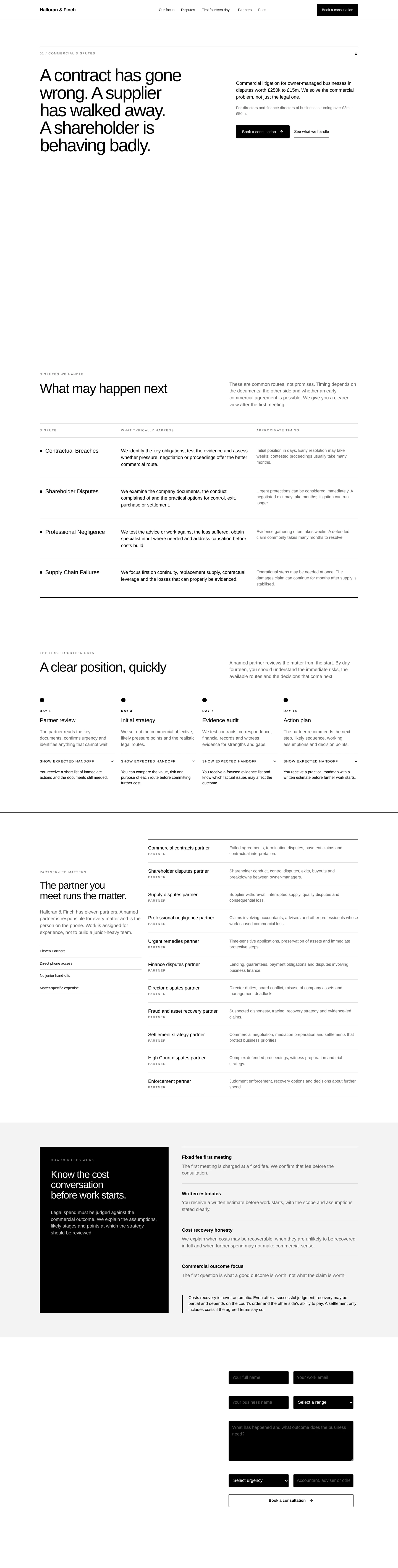
White, a numbered rule, no photography at all.
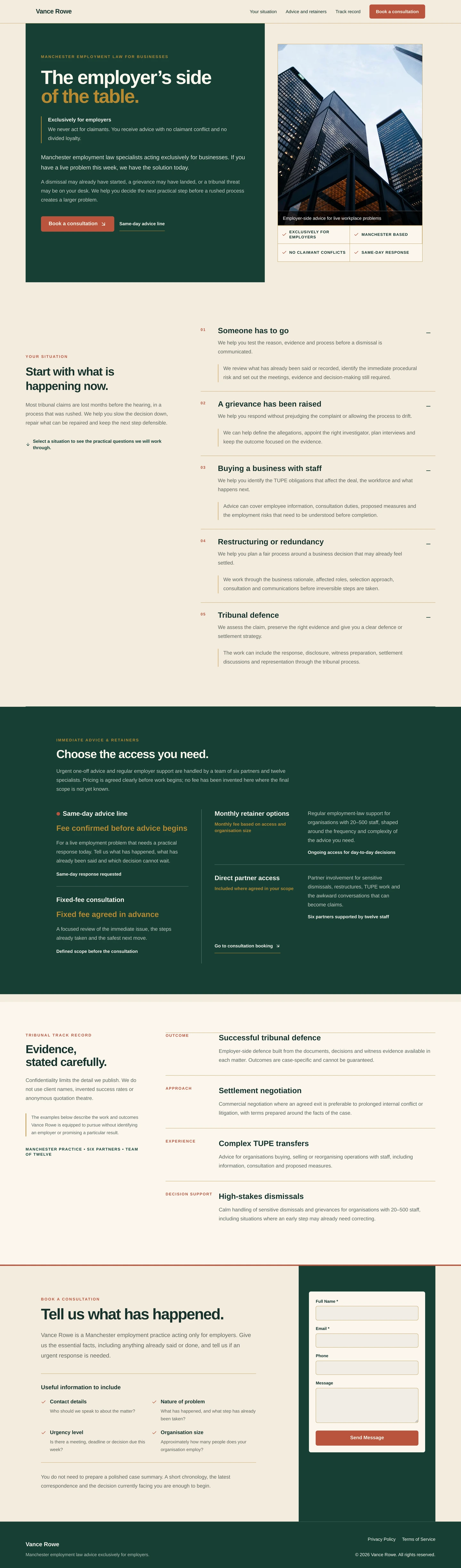
A deep green panel, gold and rust, a claim checklist.

Near-black, one gold button, a letter half in shadow.
Real generated sites, shown as demonstrations rather than clients. The firms do not exist and everything on the pages, including the numbers, is invented.
See more in the galleryThe part nobody else will say
It writes a first draft. You are the editor, and you are the one on the hook.
Generated copy is confident. Confident writing about the law, published under a firm's name, is a professional risk, and it does not become less of one because a machine typed it. So the process is built to put a solicitor in front of the words twice, before anything is public.
You approve the content plan before any design exists
Before a single page is generated you are shown what each page will say — the practice areas it found, the claims it intends to make, the structure. Cut what is wrong there and it never gets written.
Every word on the finished page is editable
Click a sentence and rewrite it, or describe the change and let the assistant make it. There is no locked template text and no copy you cannot reach.
Nothing is public until you publish it
A site sits as a draft, visible only to you, for as long as you want. Publishing is a decision somebody makes, not something that happens while you are reading.
Every version is kept
If a change goes out that should not have, the previous version is still there and can be restored.
What we will not do, and cannot do: check your site against the advertising and publicity rules your regulator sets, or verify a claim about your experience, your outcomes or your accreditations. No generated sentence about results should reach the public without a solicitor reading it first.
Practice areas
Each area is a page, because each area is a different client.
Somebody looking for help with a boundary dispute and somebody looking at an employment tribunal have nothing in common except your telephone number. A single services page tries to speak to both and reassures neither.
Written at the length it deserves
What the work involves, what a first meeting looks like, how you charge. Long is fine when the reader is worried.
Its own title in the search results
Each page has its own title and description, and the site produces a sitemap and structured data. We will not promise you a ranking; nobody honest does.
Add one when the firm takes one on
A new area of work is a new page, added when you say so, without a rebuild and without a bill for the page.
First contact
Where the enquiry actually goes.
Worth knowing precisely, because a prospective client's first message to a firm is not something to route through a service nobody chose.
The form belongs to the site
There is no third-party form service in the middle and nothing embedded from elsewhere. It is part of the site you publish.
It lands in two places
Emailed to the address you nominate, and kept in the site's own inbox. With nothing configured it goes to whoever owns the account, so an enquiry cannot fall into a gap on day one.
It becomes a record
Anyone who leaves an email address becomes a contact with a timeline of what they sent and when, so a partner picking it up later can see the whole thread.
Enquiries are not counted and not charged for. What you do with them — conflict checks, client care letters, retention — remains entirely a matter for the firm.
What this is not
It runs the website. It does not run the firm.
Not a case management system
Your matters, your files, your time recording and your accounts stay where they are. The site does not connect to them.
A client area, not a matter portal
Documents you choose to share can sit behind a client login in the site's customer area. It is not case management, and it does not know what a matter is.
Not a compliance review
Nobody at Mondovo reads your site against your regulator's rules. That review is yours to arrange.
Once it is live
It can keep in touch for the firm. A solicitor still reads it first.
The same account drafts emails and follow-ups in the firm's name. The rule for the pages applies here too: it is a first draft, and nothing goes out until you send it, schedule it or switch it on.
An update to the people on your list
A change in the rules, explained plainly, or the office hours over the holidays. It is drafted for you, waits in drafts, and a person at the firm sends it.
Somebody enquired. Then what?
An acknowledgement can go to the enquirer as soon as the form arrives. A short follow-up — what happens at a first meeting, what to bring — can start from the enquiry form, and is saved switched off until you have read it.
From the assistant you already use
Connect Mondovo to Claude or ChatGPT and ask it to add a page for a new practice area, or to draft the newsletter. The page is ready for you to read before you publish; the email waits for someone to send it.
Emails go out from the firm's own domain, once it is verified for sending.
What you can do from Claude or ChatGPTWhat it costs
Loading pricing… a month, once the site is live.
Everything before that — drafting, reading, arguing about the wording in a partners' meeting, generating another design because someone hated the first — costs nothing.
- What starts the charge
- Publishing the site on the firm's own domain. Hosting and the SSL certificate are in the Loading pricing….
- What stops it
- Taking the site offline. The month already paid for is not refunded, and the site stays in the account.
- What is never counted
- Pages, visitors and enquiries. A page per practice area costs the same as a page.
- Who else can get in
- Three people are included, and each one after that is Pricing unavailable a month.
- Where the domain lives
- Registered to the firm, at the firm's own registrar. Moving away does not mean losing it.
Questions
Asked by the partner who has to sign it off.
How do we stop it saying something untrue about the firm?
By reading the content plan before anything is designed. It tells you what each page intends to say, including any claim about experience or specialism, and you strike out or correct it there. Anything that survives to the page can still be rewritten, and nothing is public until you publish.
The first draft reads like marketing. We do not talk like that.
Rewrite it. You can edit any sentence directly, or describe the change — shorter, plainer, no adjectives — and have it applied across the page. It is a starting point, not a house style.
We already have a site with twenty years of content.
Give it the address and the pages and words come across, so you are not retyping them. You review what it found before any design is generated, and you decide what carries over.
Does it handle our regulatory disclosures?
No. You can put any wording you need on any page, in the footer or on a page of its own, but the responsibility for knowing what must appear and checking that it does is the firm's.
What if the design is too informal for us?
You are given three complete versions from the same approved content, and can ask for further rounds. A site holds up to ten and you choose which is live, so a decision made now is not permanent.
What happens if we leave?
The domain is registered to the firm at your own registrar, so it stays yours. Take the site offline and the charge stops.
Your firm
Describe the firm. Read the plan before anything is built.
You can stop at the plan and never generate a design. It costs nothing either way.
See how it works, step by step