
For trades and construction
A contractor website builder: every trade, every town, one tap to call.
Not awards, not a mission statement. What you do, where you go, what you have already built, and a number that is easy to press on a phone with one hand.
What a caller checks
Three questions, in about twenty seconds, before anyone dials.
Everything else on a trade website is decoration. If a page answers these three quickly it has done its work.
Do you do this kind of job?
A page for each trade you want to be called about. Somebody searching for a flat roof should land on a page about flat roofs, not on a list where it is the ninth bullet.
A page per service, added whenever you want another oneDo you come out here?
Write down the towns and areas you cover, plainly, on a page of its own. Half the calls a trade loses are people who could not tell whether they were too far away.
Your patch, in words, not a guessHave you done one before?
Photographs of finished work, with a line about what the job was. This is the one that decides it, and it is the one most trade sites skip.
Your own photographs, on a page that shows them properlyThe photographs
Use your own. All of them, even the ordinary ones.
A generated photograph of a kitchen you did not fit is a lie you will have to explain when you turn up. Take pictures on site, upload them, and put them where the job is described. A slightly wonky photograph of your own scaffolding beats a perfect stock one every time, because the person looking is trying to work out whether you are real.
Upload from wherever they are
Add photographs to a page, a gallery or a job. There is no separate media bill and no per-image charge.
Before and after, side by side
The strongest thing a trade can put on a website, and it needs no explaining to anybody.
Say what the job was
Two lines under each one — what it was, where, roughly how long. That is the whole case study.
One plumber, three ways — then three other trades
The same plumbing company in three designs, then an electrician, a decorator and a builder.
The top row was generated for one fictional plumbing firm from one content plan — same services, same phone number, same words — and is what a round of three looks like. The bottom row is three other trades, each built from a short description of the business.
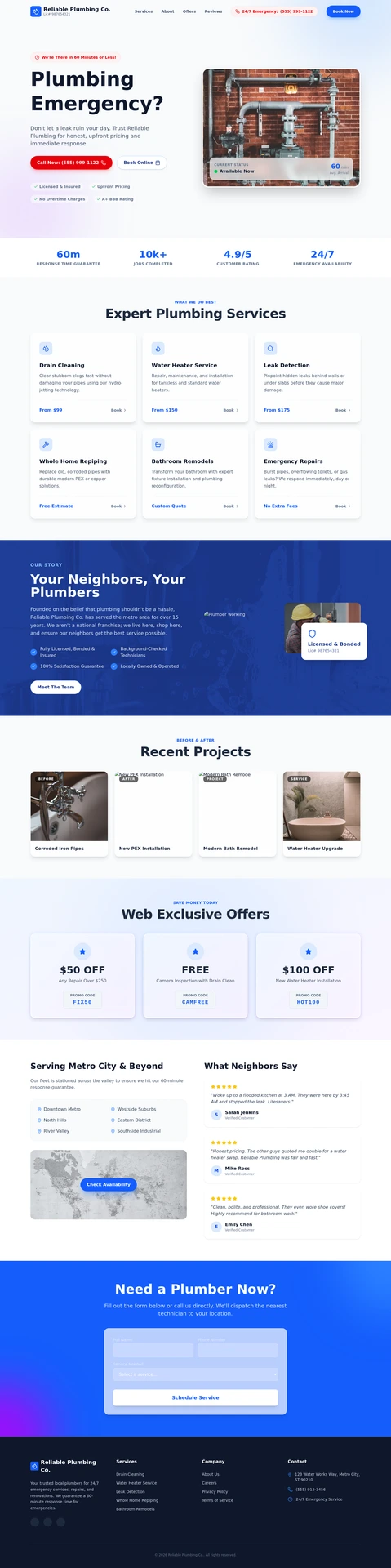
White, pale blue, a live status card.
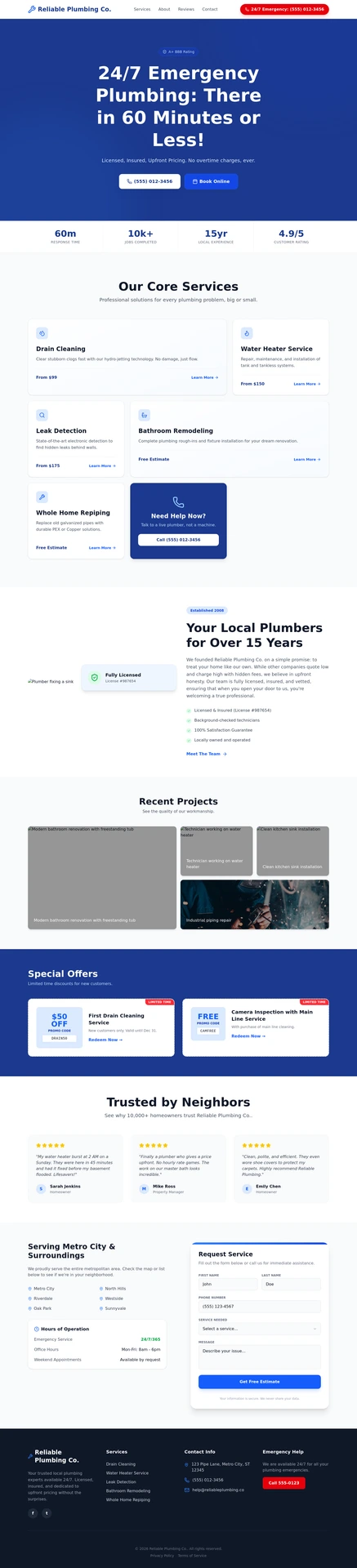
Solid blue, the promise in the headline.
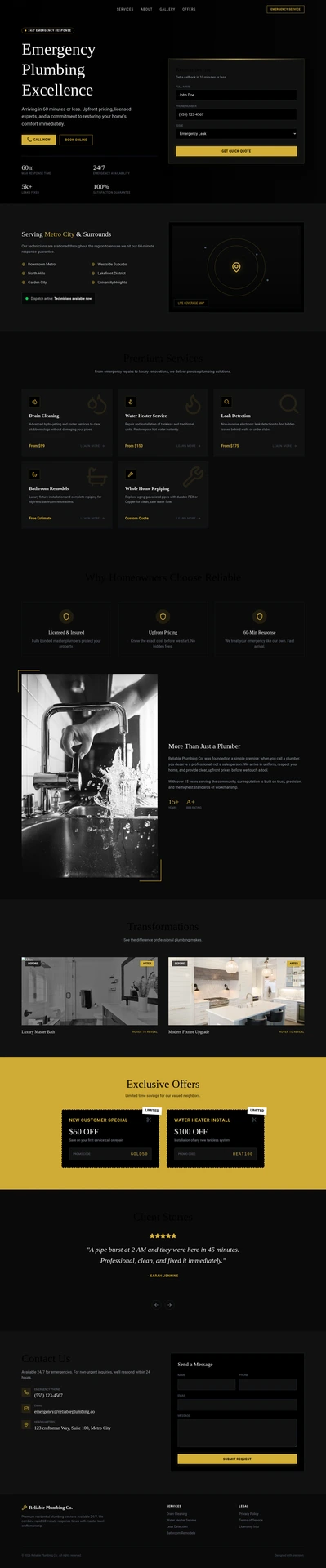
Black, with the quote form in the hero.
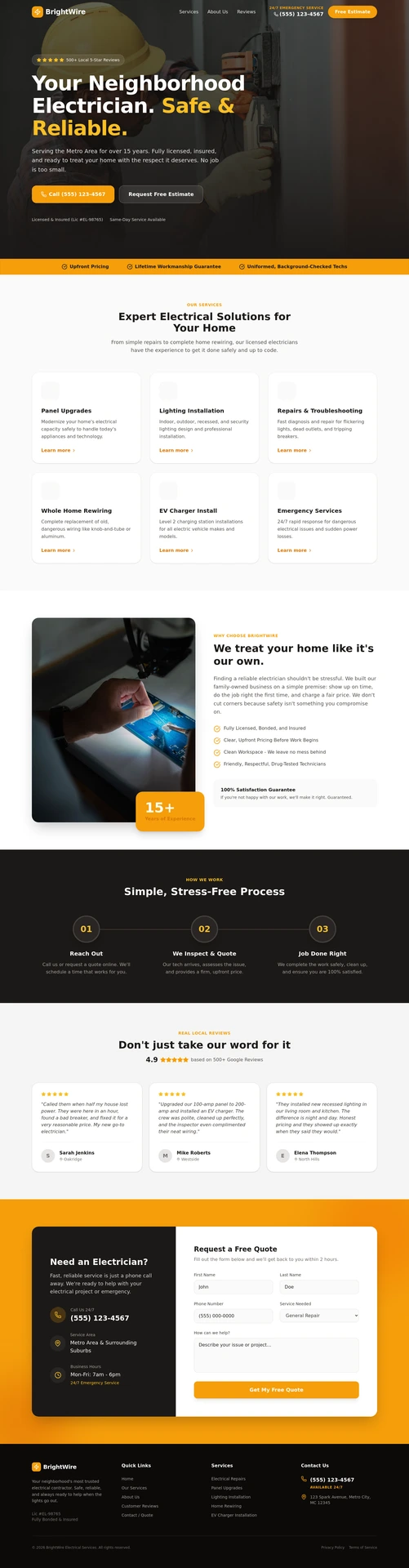
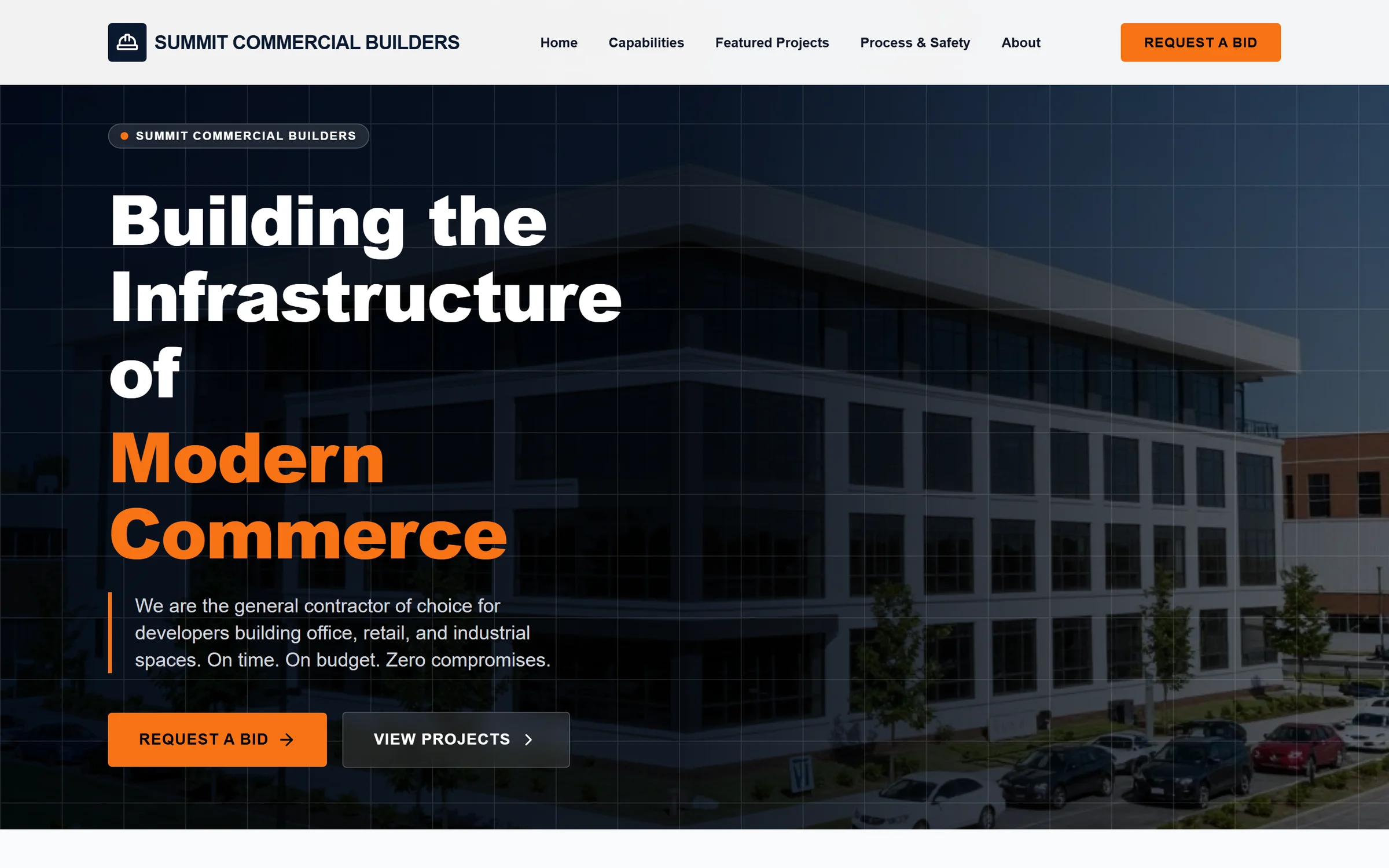
A yellow hard hat, dark grey, the number top right.
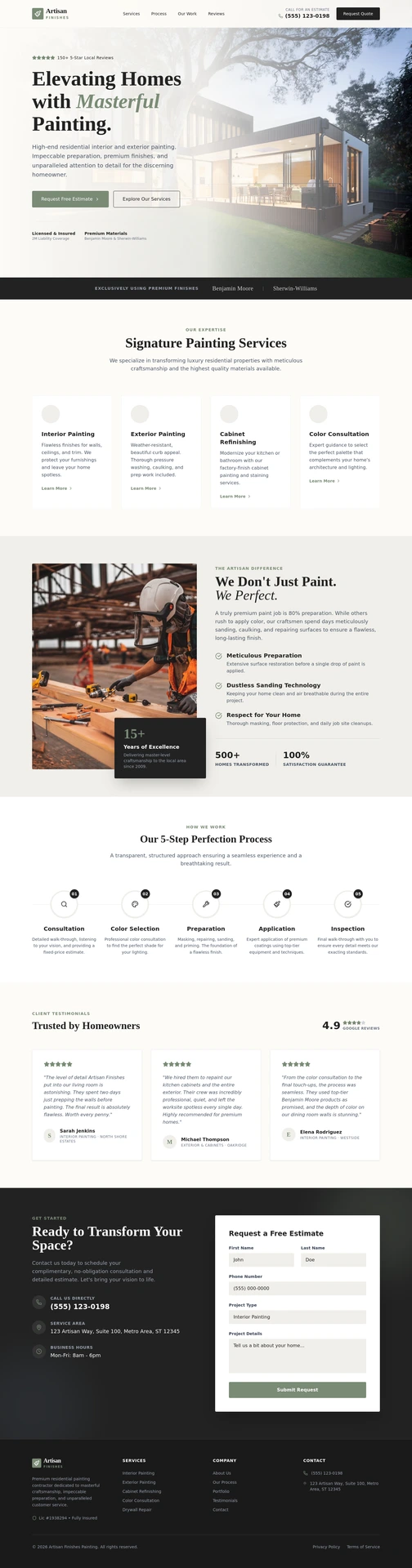
Sage green, a freshly painted house.
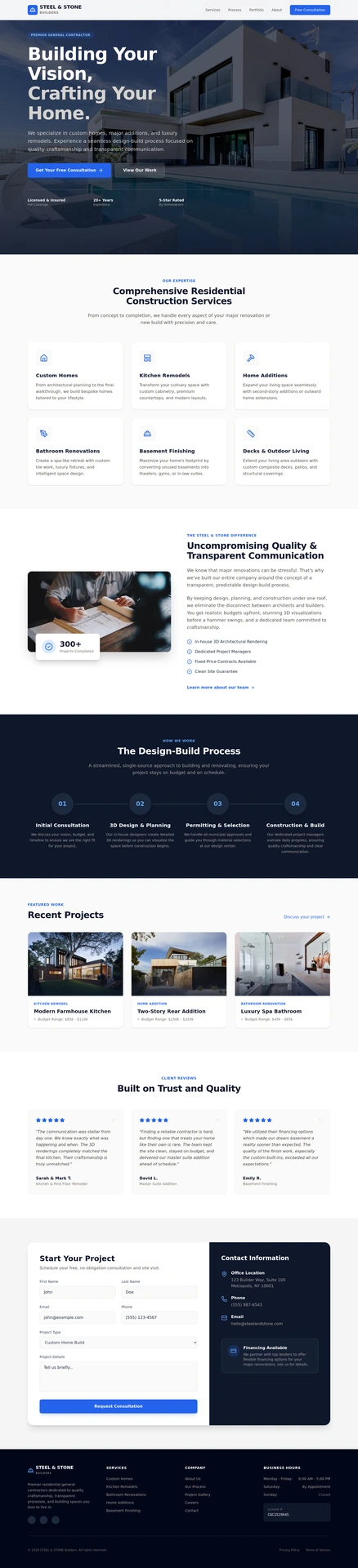
Navy and white, a finished build.
Real generated sites, shown as demonstrations rather than customers. The firms, the numbers and everything written on them are invented.
See more in the galleryThe quote request
Somebody who fills in a form at nine at night wants an answer at seven in the morning.
You will not be at a computer. The point is that the enquiry finds you anyway.
Emailed and filed
Every enquiry goes to your email and into the site's own inbox. If nothing is configured it goes to whoever owns the account, so nothing is lost while you are setting up.
Ask what you need to ask
The form is part of the site, with the fields you want on it. No separate form service, no embed, no extra monthly bill for it.
They become a contact
Anyone who leaves an email address gets a record with what they asked and when, so the follow-up call is not from cold.
No limit on how many
Enquiries and form submissions are not counted and not charged for.
Being straight with you
It is a website, with the office jobs that belong on one.
It does not price jobs
No estimating, no measure-ups, no take-offs. Quote requests come in through the site with the details you ask for; the quoting itself stays wherever it is now.
It can take bookings
A booking calendar with your availability on it, so a customer can pick a slot for a survey or a small job and get a reminder. Scheduling the lads and the vans is still yours.
It can take a deposit
Payment collection is built in, so a deposit or a fixed-price job can be paid for on the site. Invoices as documents are not part of it — your invoicing is unchanged.
Once it is live
Once the site is up, it can do some of the chasing.
The same account writes the posts, the emails and the follow-ups. Nothing goes out until you send it, schedule it or switch it on.
A quote request, followed up
An acknowledgement can go to the customer the moment the form arrives, and a follow-up a few days later, so a job does not go quiet while you are up a ladder. The follow-up is saved switched off until you have read it.
- Thanks — we will ring you tomorrow
- Still thinking about it? Here is what happens next
A reminder before, a review ask after
If surveys or small jobs are booked on the site, the customer can get a reminder the day before and an hour before. Mark the booking complete and it can send them a link to your Google review page.
The finished job, as a post
Describe the job and a post is written for you. It goes to your connected Instagram and Facebook when you schedule it, and not before.
- A bathroom finished this week
- Boiler services before the winter
- Booking up for the spring
A logo for the van, and the rest from a chat
Creative Studio makes a logo if you do not have one, and graphics for posts and offers in the site's colours. For the work itself, use your own photographs. Connect Mondovo to Claude or ChatGPT and you can ask for any of this in a sentence.
Emails to your list go out from your own domain, once it is verified for sending.
What you can do from Claude or ChatGPTWhat it costs
Free until it is live. $20 a month after that.
Per live site, per month. There is nothing else on the bill.
- Building and drafting it
- Free
- Your own domain, hosting, SSL
- In the $20
- Pages, visitors, enquiries
- Not counted
- Extra people on the account
- 3 included, $10 each after
Take the site down and the charge stops. The domain stays registered to the business, at your own registrar.
Questions
Asked from a van.
I do not have time to build a website.
Describe the business — what you do, where you work, how long you have been doing it — and a complete site is drafted from that. You read a plan of what each page will say before anything is designed, and you change what is wrong at that point.
I am not much of a typist.
Say it out loud instead. You can describe the business by voice at the start, and later ask for changes the same way. Every live site comes with credits each month, and talking uses them at 2 a minute.
Can I change it from my phone?
Yes — change the text on the page directly, or describe the change and have it made. Every version is kept, so anything can be put back.
We cover about thirty villages.
Write them down on the page. There is no limit on pages and no charge per page, so the areas you cover can be as detailed as you like.
There is an old site my nephew made.
Give it the address and the pages and words come across, then the design is rebuilt around them. You see what it found before anything is generated.
Will people find it?
Each page gets its own title and description, and the site produces a sitemap and structured data. What nobody honest will promise you is a position in the results — anyone who does is selling something else.
Your business
Say what you do and where you do it.
Ten minutes, no card, and nothing is public until you say so.
See how it works, step by step