Blog
Website Redesign Cost: What You'll Pay, and How to Keep Your Google Rankings
One quote says $1,500, another $14,000, and nobody mentions your Google rankings. Here's what a redesign really costs and how to keep your traffic.
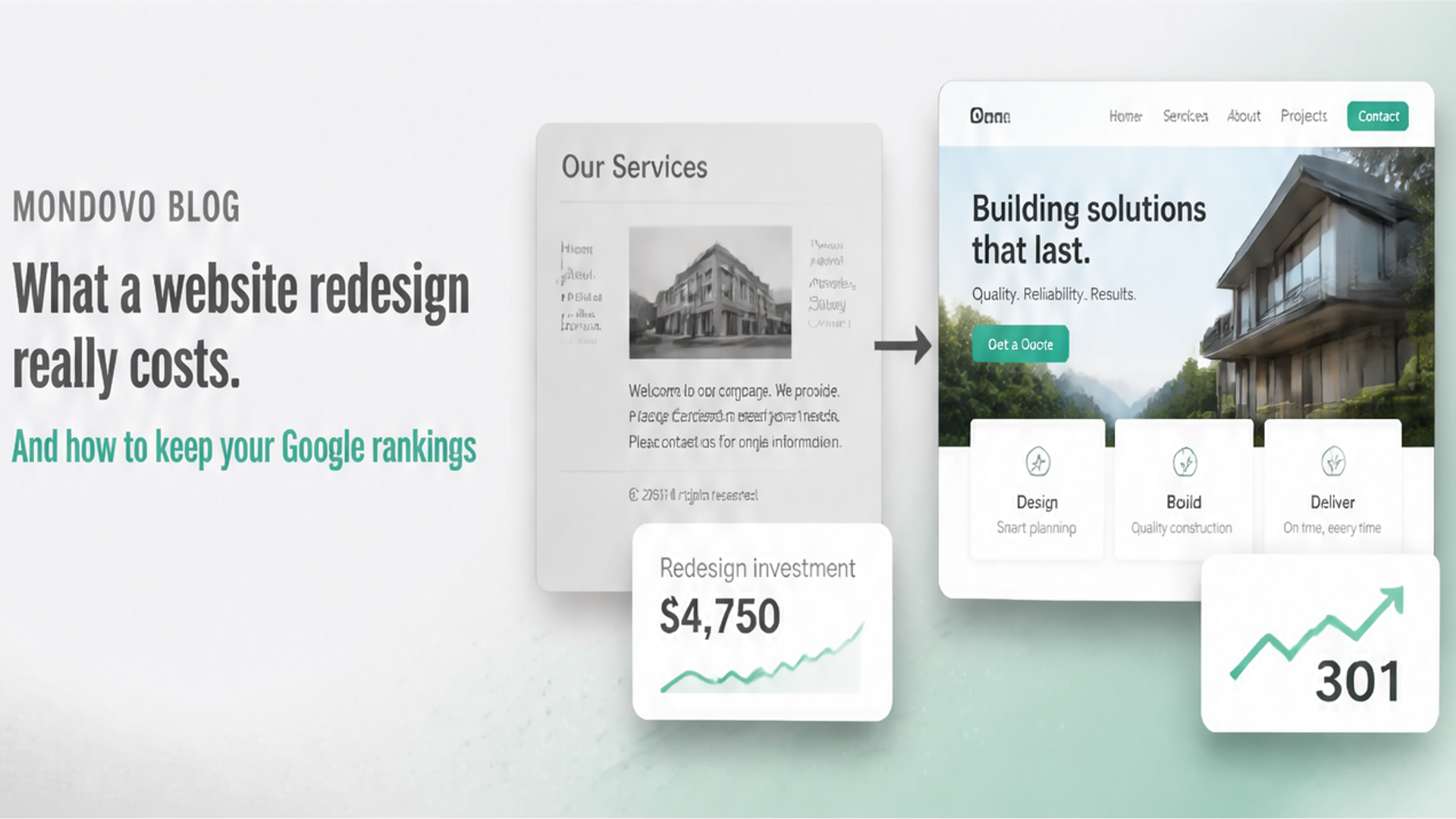
Your site is five years old. It looks dated on a phone, the booking button is buried, and you've finally asked a couple of people what a redesign would cost. One said $1,500. One said $14,000. Neither could tell you what would happen to the Google rankings you spent years building.
That second question is the one that bites. Plenty of businesses pay for a lovely new site, launch it on a Friday, and watch their enquiries drop the following month because every old page address now leads nowhere. The redesign cost money twice: once for the design, once in lost customers.
So this post covers both parts: what a redesign really costs on a builder, with a freelancer or with an agency, and how to keep your rankings through the move. I'll also show you the third way we built into Mondovo, where you paste your current address, see three new designs of your own site for free, and every old link is redirected for you.
The short answer
Do it yourself on a website builder if your site is small and you have a few weekends. You pay the builder's plan, roughly $48 to $240 a year for the cheapest plan with your own domain, plus your time rebuilding every page by hand.
Hire a freelancer if you want a custom look on a budget. WebFX's 2026 cost guide puts freelancer projects at $500 to $10,000 or more.
Hire an agency if you need strategy, branding and someone to manage the whole thing. WebFX puts agency projects at $3,000 to $30,000 or more.
Use Mondovo if you want the redesign without the rebuild. Paste your current address and it reads your pages, text, images, logo and colours, then builds three complete designs with your own content in them. Building is free, every old address is redirected to the closest new page, and going live on your own domain is $20 a month.
Website redesign cost at a glance
| Route | Upfront cost | Who rebuilds the pages | Who handles redirects |
|---|---|---|---|
| DIY on a builder | $0, plus about $48–$240 a year for the plan | You, page by page | You |
| Freelancer | $500–$10,000+ | The freelancer | Ask. It's often not in the quote |
| Agency | $3,000–$30,000+ | The agency | Usually, on bigger projects |
| Mondovo (ours) | $0: three designs of your own site, free | Read from your live site | Done for you (301), with unmatched pages flagged |
The freelancer and agency ranges are WebFX's figures for building a site, and most redesigns are priced like a rebuild, because that's what they are. Clutch's pricing research, updated in September 2026, says most web design projects reviewed on Clutch cost less than $10,000, though a few big ones pull its average up to $38,105.
What drives the price of a redesign
A redesign quote is mostly hours. These are the things that add them:
- Number of pages. A five-page plumber's site and a 60-page clinic site are different jobs, even with the same design.
- Who moves the content. Copying text and images from the old site into the new one is slow, dull work, and someone bills for it.
- New copywriting. Often quoted separately. Worth it if your old words weren't working, wasted money if they were.
- Custom features. Bookings, a store, member areas or a form that feeds your CRM all add build time.
- Where your designer is. Clutch puts shortlisted US and Canadian agencies at $100 to $149 an hour, and agencies working on builders like Wix, WordPress, Squarespace, Webflow or Shopify at $25 to $49.
- The platform move. Changing platform as well as design means redirects, testing and a careful launch. That's the part people leave out of the budget.
Mondovo: the two biggest lines, design and moving content, are the ones we took to zero. It reads your existing pages, so you start from your own words rather than paying anyone to retype them, and it shows you a plan of the pages before designing. Bookings with deposits, an online store, forms with an enquiry inbox and email are built in, so a new feature isn't a new invoice.
DIY on a builder: cheap, but your weekends
A builder is the cheapest route in cash. WordPress.com's Personal plan is $4 a month billed yearly, and Squarespace Basic is $19 a month on a yearly plan ($25 monthly). A premium WordPress theme on ThemeForest runs about $18 to $119.
The catch is that none of them reads your old site. You pick a template, then copy every page, every photo and every testimonial across by hand, and set up the redirects yourself. For a ten-page site, that's a long weekend if nothing goes wrong.
Mondovo: it's a builder too, so the costs look similar ($20 a month for a live site on your own domain, with hosting and SSL), but the weekend goes away. Paste the address, check the plan, pick one of three designs. Up to ten designs can sit on one site, so the next redesign is a click, not another project.
A freelancer: good value if you scope it tightly
A good freelancer gives you a custom look for much less than an agency. The risk is the gaps in the quote. Ask, in writing, whether it covers moving all your content, rewriting copy, mobile testing, and setting up a redirect for every old page address. If the answer to the last one is "we'll sort that out later", it won't get sorted.
The other catch: you usually see the design after you've paid a deposit, so you're paying for a guess.
Mondovo: you see three finished designs with your own content before you pay anything, because building is free. A generated design may need refining to match a strict brand guide, and that's where a freelancer still earns their fee. You can also use both: Mondovo for the build and the redirects, a designer for the brand.
If you'd rather see your own site redesigned before you collect any more quotes, try the free redesign preview or start building free.
An agency: when you're buying more than a design
At $3,000 to $30,000 and up, an agency is paying for strategy, branding, research, project management and usually a proper launch plan, redirects included. For a business with a big site, several stakeholders or a rebrand, that can be money well spent.
For a ten-page local business site, it's often more process than you need, and agency projects tend to come with a monthly retainer afterwards for changes.
Mondovo: it doesn't replace an agency's strategy work or a brand identity project. It does replace the part where you pay to have your existing pages rebuilt in a new design, and editing afterwards is free: change text and images on the page, or ask for changes in words.
Website migration SEO: keeping your rankings through a redesign
This is the part people forget, and it costs more than the design if you get it wrong. Google ranks page addresses. When a redesign or a platform move changes those addresses, and it nearly always does, Google needs to be told where each old page went. Google's own guide to site moves is the reference here, and it boils down to these steps:
- List every old address. Pull them from your old sitemap, your analytics and your site's page list. Google says "it's important to map your old site's URLs to the URLs for the new site." Don't forget blog posts and old landing pages that still get links.
- Redirect each one with a 301. A permanent redirect from every old address to the closest new page. Google recommends "server side permanent redirects from the old URLs to the new URLs". Point each page at its real match, not everything at the home page, and avoid chains of redirects.
- Keep the content and titles that rank. If a page brings in enquiries, keep its main words, its page title and its description close to what they were. A redesign is a chance to improve a page, not to delete the paragraph Google liked.
- Submit a new sitemap. Google's guide says to "submit the new sitemap in Search Console" once the move starts.
- Changing domain? Use Change of Address. Only if the domain itself changes. It isn't for moving from http to https or dropping the www.
- Keep the redirects for at least a year. Google says "keep the redirects for as long as possible, generally at least 1 year."
- Check Search Console after launch. Watch for pages Google reports as not found, and look at the pages that used to bring in traffic. Google says it "can take a few weeks or more" for a medium-sized site to settle, so a wobble in week one isn't a disaster. A pile of 404s is.
Our help page on keeping old links working after a redesign walks through the same checks.
Mondovo: steps 1 and 2 are done for you. Every old page address is redirected to the closest new page with a 301, including old .php and .html addresses and WordPress-style links, and any that didn't match exactly are flagged for you to check. Each page has its own title and description, and sitemaps and structured data are built in. Steps 5 to 7 are still worth doing yourself: Search Console belongs to you, not to any platform.
What skipping redirects actually costs
Picture a dentist with a page called "/teeth-whitening.html" that's ranked for years. The redesign renames it "/services/whitening". Without a redirect, Google's link now goes to an error page, the people clicking it leave, and the ranking fades. Multiply that by every page on the site and you've paid thousands for a design that fewer people see.
It's also the cheapest problem to prevent. A redirect map is an afternoon's work for a ten-page site, and it's the first thing I'd ask any designer about.
Mondovo: that dentist's old .html address is exactly the kind of link it redirects automatically. If you're moving from WordPress, GoDaddy, Wix or anywhere else, here's how a move works.
What I'd do instead of paying for a rebuild
Most small-business redesigns aren't really design projects. They're "make my site look current, keep everything that works, and don't lose Google" projects. That's what we built Mondovo's redesign to do.
- Your own site, three ways. Paste your current address. Mondovo reads your pages, text, images, logo and brand colours, shows you the plan, and builds three complete designs with your content in them. You pick one.
- Your rankings come with you. Every old address is redirected to the closest new page (301), and the ones that didn't match exactly are flagged.
- Bulk content comes across. Blog posts and products import from a WordPress site, a sitemap, a Shopify store or a CSV file.
- The next redesign is a click. Up to ten designs on one site; switch the live one and your words and pages stay put.
- The cost is simple. Building, redesigning and editing are free. Pro is $20 a month for one live site on your own domain, with hosting and SSL. Your domain stays registered with you.
The limits, so you can weigh them: Mondovo is a younger product than Wix, Squarespace or WordPress, with no plugin directory, and a shop's order history doesn't come across. If you need a full rebrand or something unusual, a good designer is still worth paying. See how a redesign works, or see your site redesigned for free first.
Paste your address and get three designs of your own site, free.
Costs and guidance checked on 28 October 2026 (builder prices on 20 and 21 October). They change, so check the linked pages before you buy.
Frequently asked questions
How much does a website redesign cost for a small business?
Doing it yourself on a builder costs the plan, about $48 to $240 a year, plus your time. WebFX puts freelancer projects at $500 to $10,000 or more and agency projects at $3,000 to $30,000 or more, and Clutch says most projects it reviews come in under $10,000.
Will a redesign hurt my Google rankings?
It can, if page addresses change and nobody redirects them. Map every old address to its new page with a 301 redirect, keep the content and titles that rank, submit a new sitemap and watch Search Console for errors after launch.
How long should I keep redirects after a website migration?
Google's guidance is as long as possible, and generally at least a year. There's little reason to ever remove them.
Is there a cheaper way to redesign a website?
Yes. On Mondovo you paste your current address and get three complete designs with your own content for free, with every old address redirected to the closest new page. You only pay $20 a month when you put it live on your own domain.
Should I change platforms at the same time as redesigning?
If your current platform is the reason the site feels stuck, a redesign is the natural time to move, because you're touching every page anyway. Just treat the redirects as part of the job, not an afterthought.