Blog
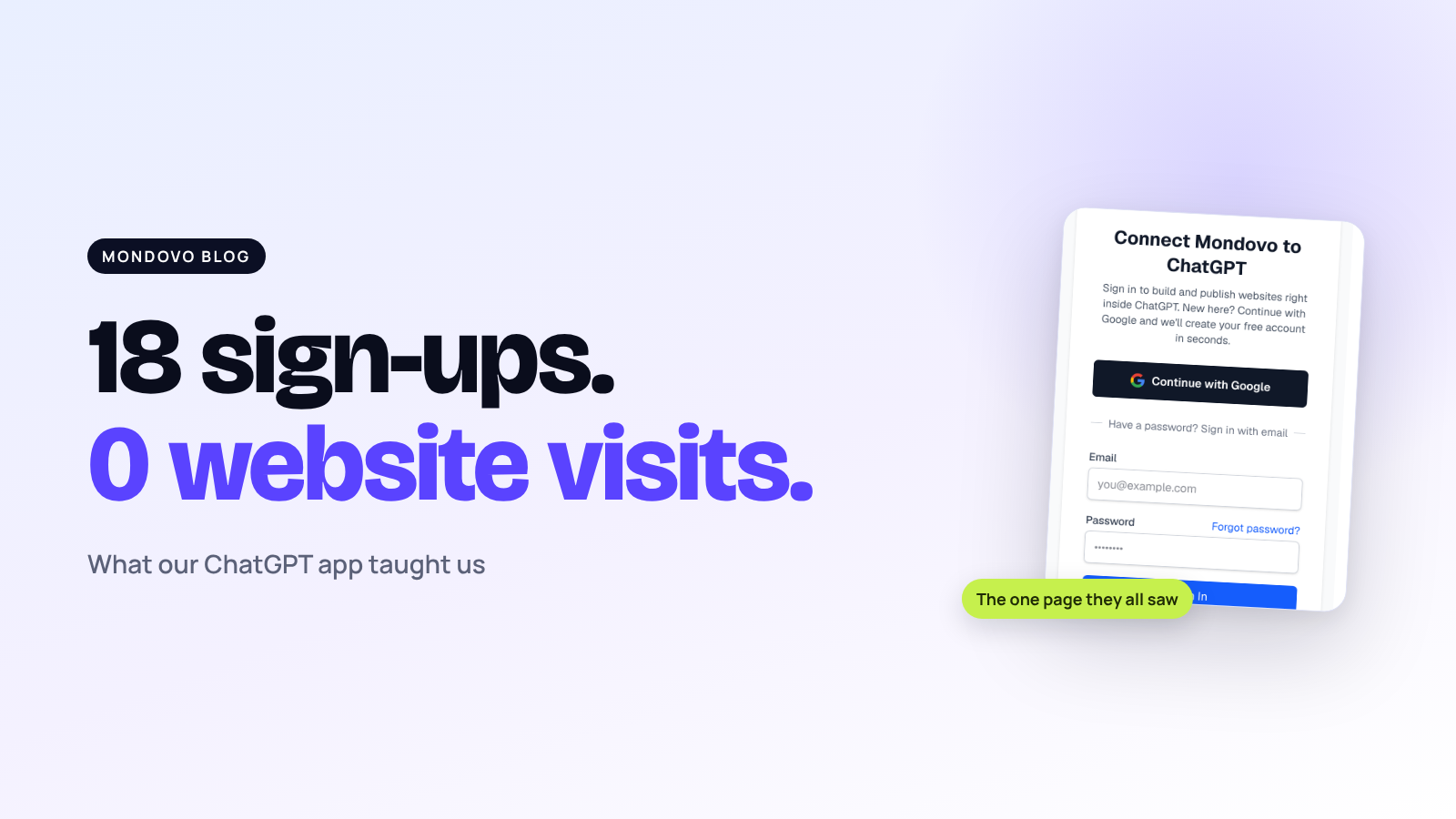
18 ChatGPT signups. No recorded visits to our website.
18 people signed up for Mondovo through ChatGPT in three days, and none of them looked at our homepage. Here's what that taught us.
We spent months on our homepage. The headline, the pricing table, the comparison pages. Then 18 people signed up for Mondovo through ChatGPT in three days, and as far as our analytics can tell, not one of them looked at any of it.
They went straight from a ChatGPT conversation to our sign-in page, and from there into building a website. (Ad blockers can hide a visit, so I can't swear nobody peeked. But nothing we recorded says they did.)
That changed what we're working on this week. Here's what happened, with the numbers.
What we did
Mondovo is an AI website builder. Agencies and freelancers use it to build client websites in minutes and sell them under their own brand.
We built a ChatGPT app for it, so you can create, edit and publish a website from inside a ChatGPT conversation. You describe the business, Mondovo builds the site, and you keep refining it in the chat.
Then we listed it in the ChatGPT app directory. That was it. No ads, no launch post, no outreach, no email to our list. The first real sign-ups arrived on 17 October.
The numbers
Over the first three days:
- About 30 clicked "connect" in ChatGPT
- 18 created a Mondovo account
- 5 built a website
- 2 published it live
The 18 came from 15 countries: the United States (3), India (2), and one each from Indonesia, Turkey, the UK, Sudan, Pakistan, Uganda, Canada, Zambia, Serbia, Vietnam, Israel, Chile and Nigeria.
These are small numbers, and I don't want to dress them up. But a small sample with no marketing behind it is a fairly clean look at one thing: what happens when an AI assistant, not your website, introduces you to people.
1. No recorded marketing-site visits
None of the 18 shows up visiting mondovo.com, before or after signing up.
They found us in the ChatGPT app directory, clicked connect, and signed up. Our homepage, pricing page and comparison pages never came into it.
What I can't see is the conversation before that click. Maybe ChatGPT suggested us. Maybe they searched the directory for "website builder". Either way, the directory listing did the job our homepage normally does.
2. We don't get to choose our customers anymore
Our positioning is clear: Mondovo is for agencies. Every page of our site says so.
Here's what the five people who built something actually made:
- a website for a numerology coach in Uganda
- a website for a political movement in Zambia
- a voice assistant site for a library
- a redesign for a company in Vietnam
- a marketplace
Not one agency. As far as we can tell, they were mostly people building something for themselves.
That's not a complaint. Two of them have live websites now, and that's what the product is for. But it's a real shift. On your own website, you decide who you're talking to. In an AI assistant, the assistant decides who you're for, based on what people ask it. The person who wants a site for their numerology practice doesn't care that our homepage says "for agencies". They never saw it.
3. The product lives in someone else's window
Every one of the sites was started inside ChatGPT. Only two people ever opened our own editor.
The rest of the work happened in the chat. People described what they wanted, and ChatGPT called Mondovo to build it, check on it and change it. While one site was being built, ChatGPT checked on its progress 51 times.
So, for most of these users, Mondovo isn't an app they open. It's something ChatGPT uses on their behalf. That changes what "good product design" means. Clear tool descriptions, fast responses and useful status updates matter at least as much as how our editor looks.
4. Our sign-in page had become our landing page, and it was a bad one
If nobody sees your website and the product mostly runs inside ChatGPT, what do people actually see?
One page: the screen where they sign in or create an account. Every one of the 18 saw it. So did everyone who left.
And about 4 in 10 people who reached that page left without signing up.
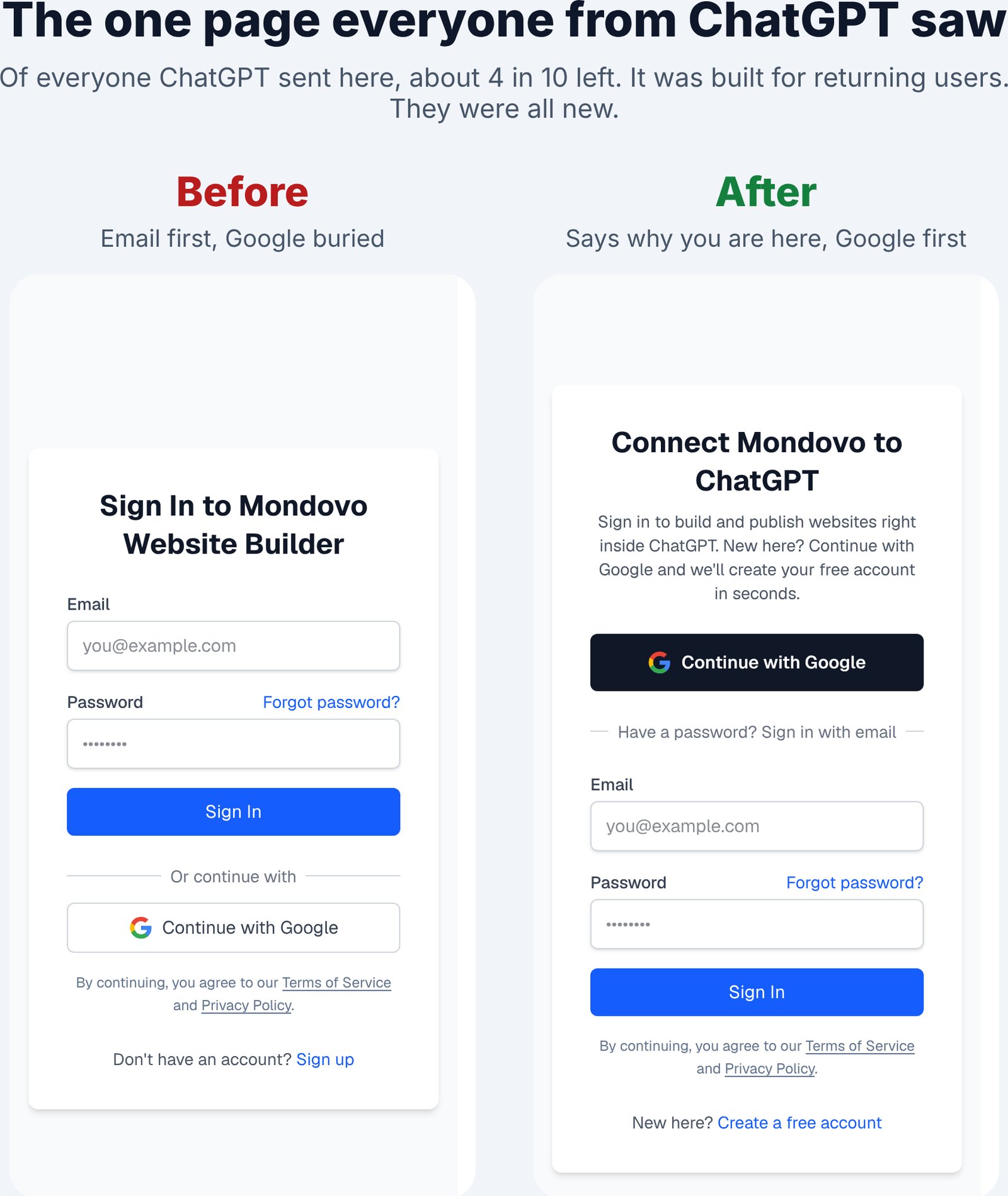
When we looked at it properly, the reason was obvious. The page was built for returning users:
- The heading said "Sign In to Mondovo Website Builder".
- The first thing on the page was an email and password form.
- The Google button sat at the bottom, under "Or continue with".
- Nothing on the page said why you were there or what would happen next.
People arriving from the ChatGPT directory were entering a connection flow. The page led with an email-and-password form instead of clearly explaining how to create or connect a Mondovo account.
Meanwhile, all 18 people who did make it through signed up with Google. Not one used email and password.
What we changed
We rebuilt the page for people coming from an AI assistant. When someone arrives from ChatGPT (or Claude), they now see:
- A heading that says what's happening: "Connect Mondovo to ChatGPT".
- One line explaining what they get: build and publish websites right inside ChatGPT, with a free account created in seconds.
- Google first, as the main button.
- Email sign-in still there for people who already have a password, clearly labelled "Have a password? Sign in with email".
It shipped the same day. We'll share whether it changes the drop-off once we have a few weeks of data.
What I'm taking from this
When an AI assistant is your front door, a few things you normally rely on stop working:
- Your homepage stops selling. Your directory listing and the assistant's first answer about you do that job now. Write the listing as carefully as you'd write a homepage.
- Your sign-in page becomes your landing page. It's the one screen everyone sees. Treat it like one: say who it's for, why they're there, and make the first step one click.
- You get whoever the assistant thinks you're for. You can shape that with how you describe yourself, but you don't fully control it. Decide whether you'll serve the people who arrive, or work harder to be suggested to the people you want.
- Your product is partly used by the assistant. How well the assistant can understand and drive your product is now a product quality issue.
If you sell software, try this: picture someone who will never visit your website. What does your product look like to them?
Try what they tried
If you're curious what these 18 people actually did, it takes about two minutes. Connect Mondovo in ChatGPT or Claude, describe your business in a sentence or two, and it builds three complete designs of your site while you keep chatting. You can change anything by asking, and publish when you're happy. Building is free, and a live site is $20 a month.
Here's how to set it up: building a website with ChatGPT or with Claude. Or just start free on Mondovo.
How we counted
For anyone who wants to check our working:
- Sign-ups are accounts created through the ChatGPT connection flow between 17 and 19 October, excluding our own team and test accounts.
- "About 30 clicked connect" is the 18 sign-ups plus roughly 10 to 12 people who reached our sign-in page and left. We removed duplicate clicks a few seconds apart and our own test runs, so treat it as approximate.
- Website visits are visits our analytics recorded on mondovo.com and linked to the person's account. Someone who blocked cookies would also show as zero, so "no recorded visit" is the accurate claim.
- Built a website means the person created a site through ChatGPT. Published means it went live on the web.
- We haven't named anyone or linked to anyone's site.